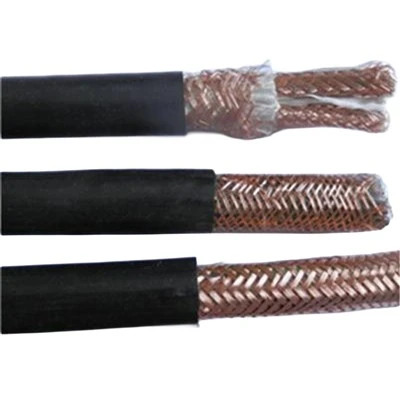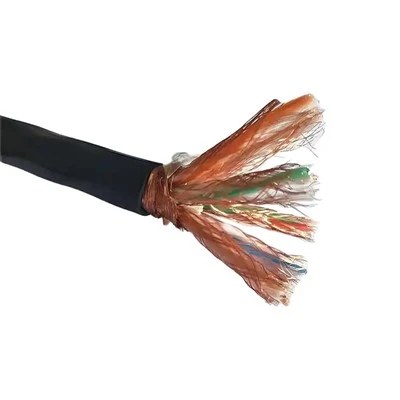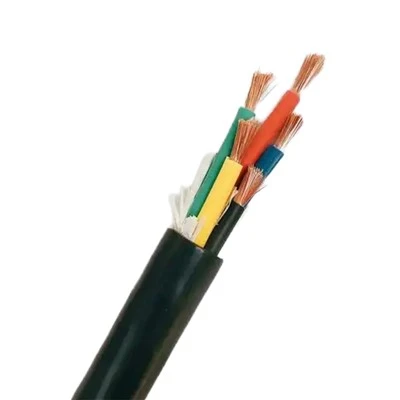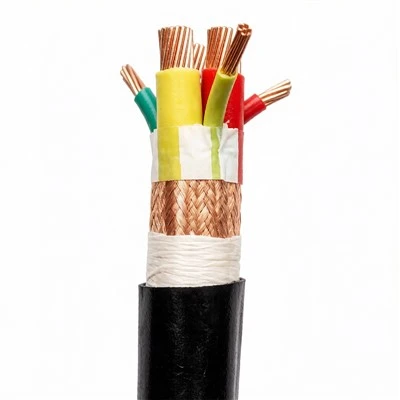

Flat cables are multi-core cables whose design and structure give them significant advantages in specific applications. The working principle of flat cables mainly involves their structure, materials, and operating environment. The following is a detailed explanation of the working principle of flat cables.
The structure of a flat cable is fundamental to its operation. Flat cables typically use multiple strands of ultra-fine stranded oxygen-free copper wire as conductors, arranged according to certain rules, such as straight lines or a staggered pattern. The conductors are wrapped with a special oil-resistant, flame-retardant blended PVC insulation material to ensure normal operation in various harsh environments. Furthermore, high-strength galvanized aerospace steel wire or other load-bearing elements can be added to both sides as needed to enhance their tensile and tear resistance.
The choice of materials for flat cables is crucial to their performance. The conductive core uses a flexible structure to ensure good cable flexibility. The insulation and protective layer materials are usually made of butyl polymers, which not only improve the cable's flexibility, corrosion resistance, and cold resistance but also allow the cable to remain flexible at low temperatures. The insulated cores are usually color-coded for ease of laying and installation.
The working principle of flat cables also relates to their performance in practical applications. Flat cables are particularly suitable for applications involving frequent bending, such as lifting machinery and overhead cranes. In these applications, flat cables do not knot or fold unevenly, thus ensuring normal operation and a long lifespan. Furthermore, the planar structure of flat cables gives them an advantage in heat dissipation, further extending their service life.
During laying and installation, the planar structure of flat cables prevents lateral shifting, saving installation time and costs. When increased tensile strength is required, reinforcing ribs or tensile galvanized steel wire can be added to flat cables. These characteristics make flat cables widely used in power connections and control signal lighting for various mobile power devices.
The working principle of flat cables is mainly reflected in their unique structural design, material selection, and application scenarios. Through these characteristics, flat cables can maintain good working performance in various harsh environments, meeting the diverse needs of industrial production and daily life.